Semantic Web Technologies
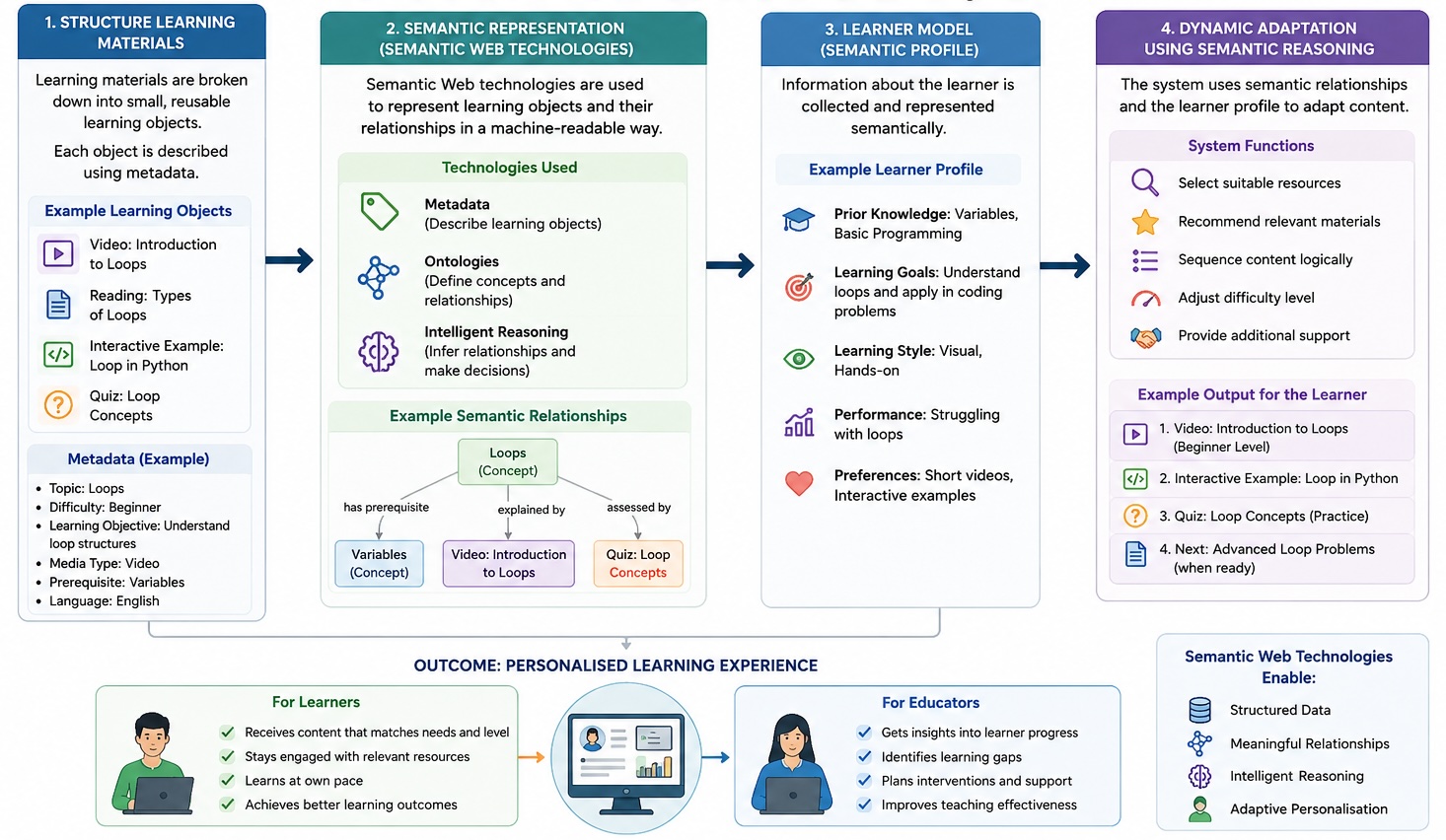
This process involves the creation of personalised learning content using Semantic Web technologies. It includes structuring learning materials into machine-readable data through methods such as metadata, ontologies, and intelligent reasoning mechanisms. These structured resources can then be dynamically organised and assembled to create personalised learning materials tailored to individual learner needs. This enables intelligent systems or machines to dynamically select, recommend, sequence, and present learning content based on learners’ needs, characteristics, and learning contexts.
References
- Adorni, G., Battigelli, S., Brondo, D., Capuano, N., Coccoli, M., Miranda, S., et al. (2010). CADDIE and IWT: Two different ontology-based approaches to anytime, anywhere and anybody learning. Journal of e-Learning and Knowledge Society.
- Gladun, A., Rogushina, J., García, F., Martinez-Bejar, R., & Fernández-Breis, J. T. (2009). An application of intelligent techniques and semantic web technologies in e-learning environments. Expert Systems with Applications, 36(2), 1922–1931.
- Ilkou, E. (2026). Semantic web and language technologies for adaptive education.
- Panagiotopoulos, I., Kalou, A., Pierrakeas, C., & Kameas, A. (2012). An ontology-based model for student representation in intelligent tutoring systems for distance learning. AICT (Part 1), 381, 296–305. https://doi.org/10.1007/978-3-642-33409-2_31
- Paquette, G., Marino, O., & Manrique, R. (2023). Semantic web innovations for higher education. IEEE Transactions on Learning Technologies.
- Wang, L., Han, W., & Xi, Z. (2025). Exploring semantic web tools in education to boost learning and improve organizational efficiency. International Journal on Semantic Web and Information Systems, 21(1), 1–27.